Cooling fans for 3D printers: two fans, two approaches

3D printers usually have more than one fan, but they perform entirely different functions. Confusing the hot-end fan with the model-cooling fan is the most common mistake made when selecting a model. Understanding the fundamental difference between ‘axial-flow’and ‘centrifugal’fans is more useful than memorising any specific model numbers.
Axial fans: they blow air, but are sensitive to resistance
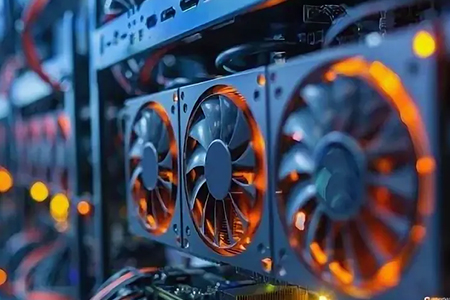
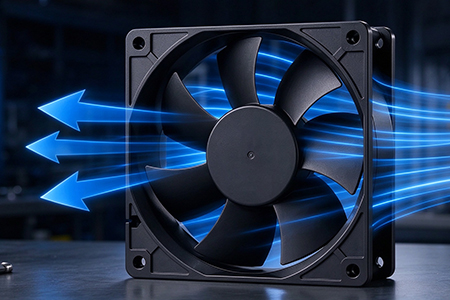
In an axial fan, the airflow runs parallel to the axis of rotation, with the blades pushing air straight out like a propeller. Its advantages include high airflow, a slim profile and low noise levels; even in small sizes, it remains relatively quiet. However, its shortcomings are equally evident: it has relatively low static pressure, and once the airflow encounters dense heat sink fins or a narrow air duct, the airflow rapidly diminishes.
This is precisely the typical operating condition for hot-end cooling fans. The hot-end heat sink is responsible for preventing heat from being conducted upwards along the thermal break; if cooling is insufficient, the consumables will soften and expand before reaching the melting zone, causing ‘thermal creep’ blockages. What a hot-end fan requires is not to ‘blow air far’, but to continuously remove heat from the heat sink whilst maintaining low noise levels. Axial-flow fans are a suitable choice for this application.
Centrifugal fans: Forcing air through, specifically designed to tackle high resistance
Centrifugal fans draw air in axially and then expel it through a narrow side outlet via a centrifugal impeller. Rather than prioritising total airflow, they use high static pressure to ‘force’ air into areas of high resistance. The cooling ducts in 3D-printed models are often narrow and situated close to the nozzle; by the time air from a standard axial fan reaches this point, much of its momentum has already been lost, whereas a centrifugal fan maintains sufficient dynamic pressure to precisely target the freshly extruded molten filament.
Therefore, when selecting a cooling fan for a 3D printer, one should prioritise static pressure over airflow. A common upgrade involves replacing the original axial fan with a compact centrifugal fan; the latter provides more concentrated, directional cooling, thereby reducing stringing and overhang issues. Many complete printer solutions adopt this division of labour: the centrifugal fan handles directional cooling at the nozzle, whilst the axial fan manages continuous heat dissipation for the hot end and electronic components.
An often-overlooked factor: the air duct
Even the best fan will be compromised if fitted to a poorly designed air duct. A tapered and flared geometric design within the duct can significantly improve the average airflow velocity, whilst an ill-designed duct may result in the combined cooling effect of two fans being inferior to that of a single fan. Before agonising over whether to ‘upgrade to a more expensive fan’, it is often more beneficial to first check for air leaks in the duct and ensure the outlet is aligned directly beneath the nozzle.
If a problem arises, don’t rush to replace the fan
A typical sign of thermal creep is a material jam mid-print, particularly with high-temperature materials such as PETG or ABS. To diagnose the issue, touch the cold end above the thermal break during printing: it should be cool; if it feels warm or even hot to the touch, this indicates that the hot-end fan is on the verge of failure. Unusual fan noise is also worth noting; a grinding sound or intermittent clicking usually points to bearing wear, rather than the assumption that ‘as long as the fan is still spinning, it’s fine to leave it’.
Another common mistake is fitting the fan the wrong way round. If clogs become worse after replacing the fan, the first thing to do is check the airflow direction: the air should be blowing towards the heat sink, not being drawn away from it.
The One-Sentence Principle
For hot-end cooling, choose axial-flow fans: they are quiet, adequate and slim; for model cooling, choose centrifugal fans: prioritise air pressure, as static pressure is more important than airflow. First ensure that the airflow path is not a bottleneck, then upgrade the fans themselves. Cooling is not about ‘the stronger the airflow, the better’, but rather about delivering the right air pressure to the right place.
Ageing tests on cooling fans: what they can and cannot prove