Highly Corrosive Environments: Corrosion Protection Solutions for Cooling Fans

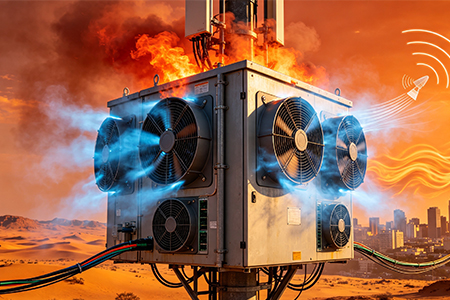
In solar power stations, coastal telecommunications base stations, chemical processing plants or food processing factories, the conditions faced by cooling fans are far harsher than those in ordinary server rooms. Constant exposure to salt spray, sulphurous gases, oil residue and high-humidity air means that it is often not the fan blades that bear the brunt of the damage, but the fragile circuit board inside. Should the motor windings or drive circuitry become corroded and short-circuited, causing the fan to stop, the heat generated by downstream equipment will have nowhere to dissipate. The core principle of corrosion protection is clear: seal off components susceptible to corrosion and replace exposed parts with corrosion-resistant materials.
Currently, the industry widely recognises potting as the most effective solution. Potting involves directly pouring epoxy resin over the fan’s windings and the circuit board; once cured, this forms a dense physical barrier that completely seals out salt, moisture and corrosive gases. This process is not merely a matter of applying a coat, but is implemented in tiers according to protection requirements. Taking Meibaya Sanmei’s grading system as an example: the lowest grade of insulation coating provides only basic protection against dripping water and dust; whereas the highest grade of full potting involves mould-compressing the drive circuit, stator and windings entirely within an epoxy resin casing, achieving a protection rating of IP68 or even IP69K. This enables the unit to withstand immersion in salt water, corrosion from sulphuric gases and even high-pressure, high-temperature washing. For equipment such as domestic PV inverters, which are exposed to the elements year-round, the use of the third-level ‘Encapsulation II’ process—in which the stator and circuit boards are placed within the housing ring before being filled with resin—has been proven to significantly reduce circuit board corrosion and has passed TÜV testing and certification.
The choice of materials and surface treatments for the housing and fan blades constitute the first line of defence. In maritime climates or chemical industrial zones, conventional plastic fan blades are prone to accelerated ageing and cracking; aluminium alloy or stainless steel are more reliable materials. However, the metal itself still requires treatment: anodising can enhance the surface hardness and corrosion resistance of aluminium, whilst scenarios with more stringent requirements may utilise vacuum coating processes to deposit wear- and corrosion-resistant coatings such as chromium nitride, thereby balancing heat dissipation and protection. When it comes to the fasteners securing the fan frame, the details are equally critical—in industrial specifications with high corrosion levels, fasteners are explicitly required to be made of 316 stainless steel, whilst electro-galvanised parts are categorically excluded, as once the plating is damaged, rust will silently spread through the gaps.
Finally, it is important to recognise a reality: no single treatment solution offers a permanent fix. Encapsulation processes may slightly compromise the circuit board’s heat dissipation capacity, whilst coatings may develop micro-cracks after prolonged thermal cycling; even the best seals cannot withstand impact damage during installation. Therefore, in extremely corrosive environments, designing fans as replaceable modules is far more practical than pursuing ‘permanent corrosion protection’. Focusing on IP ratings and salt spray test durations during selection, whilst taking care not to damage the coating or sealing surfaces during installation, is the surest way to ensure that cooling fans reach their design lifespan in highly corrosive environments.
Fan Speed and Airflow: How Speed Affects Airflow, Air Pressure and Power