DC Fans versus AC Fans: A Silent Revolution in the Future of Cooling
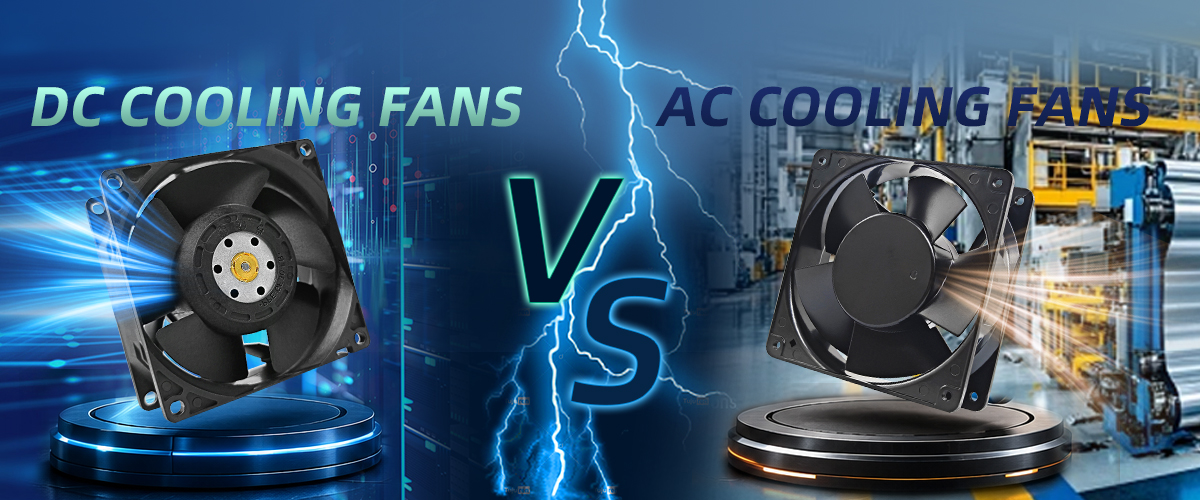
As a manufacturer of cooling fans, one of the questions we are most frequently asked in our day-to-day interactions with customers is: ‘Should I choose a DC fan or an AC fan?’ This question reflects the profound transformation currently taking place across the entire cooling industry. Today, I would like to share our understanding and observations of these two technologies from a manufacturer’s perspective.
AC Fans: A Time-Tested ‘Reliable Partner’
AC fans are a familiar sight in the field of heat dissipation. Their advantages are clear: they connect directly to the mains supply (110V or 220V), have a relatively simple design, are manufactured using established processes, and benefit from a stable supply chain. In cost-sensitive scenarios and harsh environments, AC fans remain a practical choice to this day.
For instance, in industrial environments characterised by high temperatures, dust and oil contamination, AC fans demonstrate even greater resilience; through specialised manufacturing processes, they can achieve an IP55 protection rating and operate reliably within the extreme temperature range of –50°C to 90°C. They remain a dependable solution in applications such as large electrical cabinets and traditional industrial equipment.
DC Fans: Designed for the ‘Smart Era’
DC fans, particularly those utilising brushless DC (BLDC) motor technology, have seen very significant growth in recent years. Their core advantages align perfectly with the three major trends in current equipment development: energy efficiency, smart functionality and portability.
Firstly, there is a generational leap in energy efficiency. For the same airflow, DC fans can consume up to 70 per cent less power than AC fans. In environments such as data centres and renewable energy facilities that operate 24 hours a day, 7 days a week, this energy-saving difference adds up to a substantial amount over the course of a year.
Secondly, there is the flexibility of intelligent control. DC fans inherently support PWM (Pulse Width Modulation) speed control, allowing them to dynamically adjust their rotational speed based on the heat generated by the equipment. Most AC fans, by contrast, can only operate at a constant speed. When the equipment is under light load, DC fans can automatically reduce their speed, resulting in lower noise levels and more precise temperature control—a decisive advantage in fields sensitive to noise and stability, such as medical equipment and high-end servers.
Finally, there is the safety and compatibility offered by low voltage. DC fans typically operate at low voltages such as 5V, 12V and 24V; this is not only safer but also allows them to integrate directly with the DC power supply architecture found inside modern devices, eliminating the need for additional AC-DC conversion. This makes them naturally suited to applications such as portable devices, telecommunications base stations and in-vehicle systems.
Making a Rational Choice: There is no ‘best’ option, only the ‘most suitable’
Returning to the customer’s question, our answer is never a one-size-fits-all statement such as ‘DC is better’ or ‘AC is cheaper’. The correct choice always depends on the equipment’s application scenario and design specifications.
If your equipment prioritises budget, operates in a simple mains environment, and has no specific requirements for speed control or noise levels—such as basic industrial control cabinets or traditional household appliances—an AC fan is a proven and cost-effective solution.
If your equipment prioritises high energy efficiency, low noise and intelligent temperature control; requires long periods of continuous operation; or is powered by batteries or low-voltage sources—such as data centre servers, medical monitors, high-end power supplies or portable energy storage devices—then a DC fan is the superior, future-proof solution.
EC Fans: A ‘New Species’ Combining the Best of Both Worlds
I would also like to mention a ‘hybrid’ technology here—the EC fan (electronically commutated fan). Essentially, it utilises a brushless DC motor but incorporates a built-in AC-DC conversion circuit, allowing it to be connected directly to the mains. It combines the advantages of AC fans—namely, ‘convenient power connection’—with those of DC fans—‘high efficiency, energy savings and intelligent speed control’—and is finding increasingly widespread application in fields such as heating, ventilation and air conditioning (HVAC) and the cooling of high-end equipment.
Our Perspective
This evolution from AC to DC (and even EC) is, at its core, driven by the demand for thermal management solutions in end-user devices, shifting from the notion that ‘any fan will do’ to the need for ‘just the right amount of airflow’. As a manufacturer of cooling fans, we offer not merely AC or DC fans, but comprehensive thermal management recommendations based on a thorough assessment of the device’s thermal load, operating environment and energy efficiency targets.
After all, only the technology best suited to the specific application can truly ensure the stable and efficient operation of the device.
The Importance of Thermal Management in Electric Vehicle Chargers
Selecting bearings for DC cooling fans: ball bearings vs hydraulic bearings – which is quieter?