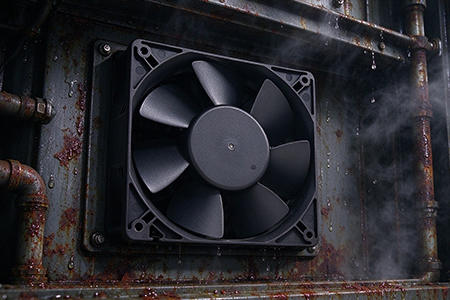
Selecting bearings for DC cooling fans: ball bearings vs hydraulic bearings – which is quieter?

When it comes to the requirement for quiet operation in DC cooling fans, hydraulic bearings (including FDB bearings) outperform ball bearings in terms of absolute silence, particularly during the initial stages of a product’s life. However, when considering the entire life cycle, ball bearings offer more consistent noise performance and are more advantageous in the long term.
The Secrets Behind the Quiet Operation of Both Bearing Types
Ball bearings utilise rolling friction and contain precision steel balls. Their advantages include exceptional durability (with a service life of 60,000–70,000 hours or more), the absence of oil leakage, and suitability for equipment operating at high temperatures, high speeds or requiring prolonged operation. However, they are inherently slightly noisier and may produce a distinctive high-frequency ‘bearing noise’ that is easily detected by users with sensitive hearing.
Hydraulic bearings are essentially an improved version of oil-lubricated bearings, utilising superior lubricants and sealing structures. They suspend the shaft core within a layer of oil film, preventing direct metal-to-metal friction. Consequently, they operate extremely quietly during the initial running-in period, with virtually no high-frequency noise, making them the current mainstream choice for those seeking quiet operation.
The Key Divide: New Fans vs Older Fans
Short-Term Noise-Reduction Champion: Hydraulic Bearings
When a fan is first brought home, hydraulic bearings are the clear winners in terms of noise reduction. As there is no clattering sound from metal balls, friction is minimal, and the noise consists almost entirely of the sound of air passing through, resulting in a very pure sound. High-end FDB bearings can even achieve a theoretical lifespan of 300,000 hours.
Long-Term Noise-Reduction Guardian: Ball Bearings
The weakness of fluid dynamic bearings lies in their long-term reliability. Over time, the lubricant may evaporate or be affected by dust, leading to increased friction, a gradual rise in noise levels, and even the occurrence of abnormal noises.
The advantage of ball bearings, however, lies in their stability. They are virtually unaffected by lubricant evaporation, and even after years of use, noise levels remain at factory specifications. Consequently, ball bearings deliver more consistent noise performance throughout the fan’s entire lifecycle.
Selection Recommendations
● For those seeking the ultimate in silence, and for short- to medium-term use: choose hydraulic bearings (including FDB) for the best experience.
● For equipment operating under high loads or at high temperatures, or requiring year-round, non-stop operation: choose ball bearings. Although the initial noise level is slightly higher, they ensure long-term stable operation and avoid the need for frequent fan replacement due to increased noise later on.
DC Fans versus AC Fans: A Silent Revolution in the Future of Cooling
Router Cooling Solutions: Why OEMs Should Give Serious Consideration to Active Cooling