Cooling fans in energy storage systems solve heat dissipation issues

With the growing popularity of outdoor camping, emergency power supplies and home energy storage, energy storage units are becoming increasingly widespread. Many people have noticed that high-power energy storage units generate significant heat when powering devices. If this heat cannot be dissipated, it may, at best, affect battery life; at worst, it could trigger over-temperature protection or even pose a safety hazard. The key component for resolving this issue is, in fact, a small cooling fan.
Why do energy storage power supplies generate heat?
Energy storage power supplies incorporate lithium-ion battery packs and inverter circuits. When they output 220V AC or high-power DC, the MOSFETs in the inverter, the transformer and the battery cells all generate heat. The higher the power output, the more pronounced the heat generation. This is particularly true for energy storage power supplies ranging from several hundred watts to over a kilowatt; after half an hour of continuous operation, the casing temperature may reach 50–60°C. Without active cooling, the internal temperature will continue to rise.
Passive cooling is insufficient
Some small energy storage units rely solely on an aluminium alloy casing and thermal silicone pads for passive cooling. This method has no moving parts and is quiet and reliable. However, once the power output exceeds 200W, passive cooling becomes inadequate. Air is a poor conductor of heat, and natural convection alone cannot dissipate the heat quickly enough. At this point, an active cooling device—a cooling fan—must be installed.
How do cooling fans facilitate heat dissipation?
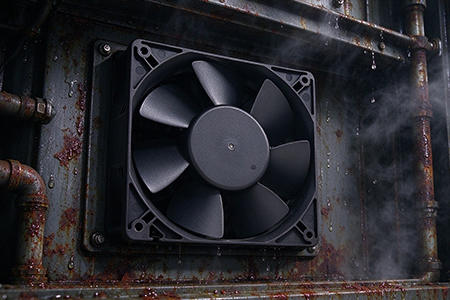
Cooling fans accelerate heat exchange by forcing airflow. A typical design involves creating an air duct within the energy storage system: the fan draws air in from one side, and the airflow passes sequentially over the inverter heat sinks, the surface of the battery pack and the charge/discharge control board, before finally being expelled through an outlet on the other side. Heat sinks increase the surface area in contact with the air, whilst high-speed airflow carries the heat away, thereby keeping the core temperature within a safe range.
A common configuration involves two fans—one for intake and one for exhaust—creating a through-flow. Some high-end models also employ temperature-controlled variable-speed fans, which remain stationary or operate at low speed under low load, and automatically increase speed under high load, balancing cooling efficiency with noise levels.
Fan selection is critical
When selecting cooling fans, energy storage power supply manufacturers need to consider several factors:
● Airflow: This determines cooling capacity and is generally calculated based on the power supply’s wattage and permissible temperature rise.
● Noise: Noise levels are a key consideration in domestic and camping scenarios. High-quality fans use fluid dynamic bearings (FDB) or hydrodynamic bearings, which are quieter and more durable than oil-lubricated bearings.
● Lifespan: Energy storage power supplies are typically designed for a lifespan of over five years; fans must operate continuously for thousands or even tens of thousands of hours, with dual ball bearings offering the greatest durability.
● Dimensions and voltage: Common sizes include 40mm, 60mm and 80mm fans operating at 12V or 5V.
What should users be aware of?
If you already own a battery storage unit, we recommend paying attention to the following points:
1.Keep the ventilation openings clear: Do not place the battery storage unit in an enclosed cabinet whilst in use; ensure there is at least 10 cm of clearance for ventilation.
2.Clean dust regularly: Dust accumulation at the fan intake can significantly reduce airflow; use a soft-bristled brush or compressed air to clean it.
3.Be alert to unusual noises: If the fan makes a clicking sound or vibrates noticeably, this may indicate bearing wear; contact after-sales support promptly to arrange a replacement.
Although the cooling fan is a small component, it plays a vital role in ensuring the stable operation of high-power energy storage systems. By providing forced air cooling, it promptly dissipates internal heat, ensuring that the battery and inverter always operate within the appropriate temperature range. When selecting an energy storage system, it is worth checking whether the product is equipped with an intelligent temperature-controlled fan, as this often translates to a longer service life and enhanced safety. By using and maintaining the cooling fan properly, your energy storage system will serve you more durably and reliably.
Installing a cooling fan on a 3D printer to resolve heat dissipation issues
The Role of Cooling Fans in Heat Dissipation for Digital Signage Displays and Their Advantages