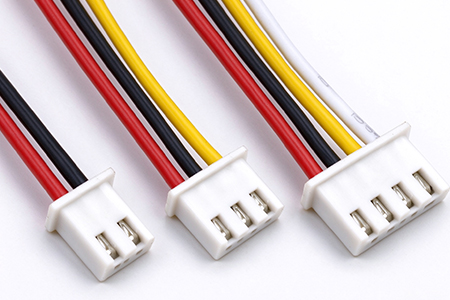
Polarity protection for cooling fan

Polarity protection of a cooling fan is a protective mechanism to prevent damage caused by reversing the positive and negative poles of the cooling fan. The following is a related introduction:
necessity:
If the positive and negative poles of a DC cooling fan are reversed, it may cause the fan to malfunction and irreversible damage to the equipment, as follows:
1. Burn the fan drive circuit: The motor of a DC fan is usually driven by an integrated circuit (IC), which is very sensitive to the polarity of the power supply. If the positive and negative poles are connected in reverse, it may cause the current direction to deviate from the design, which may result in a short circuit or overload of the driver IC, causing the circuit to overheat. Long term incorrect wiring may burn out the driver IC and cause the fan to completely fail.
2. Damage to motor stator or other components: Some DC fans use single winding drive ICs, and their internal circuits do not have protection design for polarity reversal. In this case, if the power supply is reversed, the motor stator and circuit components on the PCB may be damaged due to the reverse flow of current, which not only affects the normal operation of the fan, but also may cause the circuit components to burn out, and even result in the entire fan being irreparable.
principle:
Polarity protection for cooling fans is usually achieved by installing polarity diodes on the circuit board (PCB) of the fan.
Polarized diodes have unidirectional conductivity and only allow current to flow from the positive pole to the negative pole. When the positive and negative poles of the power supply are reversed, the diode is in a reverse cutoff state, causing the current to be zero, thereby preventing the current from flowing through the circuit and avoiding burning the fan due to the reverse current.
Polarized diodes have unidirectional conductivity and only allow current to flow from the positive pole to the negative pole. When the positive and negative poles of the power supply are reversed, the diode is in a reverse cutoff state, causing the current to be zero, thereby preventing the current from flowing through the circuit and avoiding burning the fan due to the reverse current.
circuit design:
On the PCB board of the cooling fan, the polarity protection circuit is usually composed of one or more polarity diodes. These diodes are installed at the power input of the fan, in series with the fan's motor and other circuit components. When the positive and negative poles of the power supply are correctly connected, the diode is in a forward conducting state, the current can pass smoothly, and the fan works normally. When the positive and negative poles of the power supply are reversed, the diode is in a reverse cutoff state, and current cannot pass through. The fan will not be powered on, thus providing protection.
Key Applications of Cooling Fans in Industrial Automation Equipment
Why are more and more device manufacturers choosing domestic cooling fans instead of imported and Taiwanese ones?