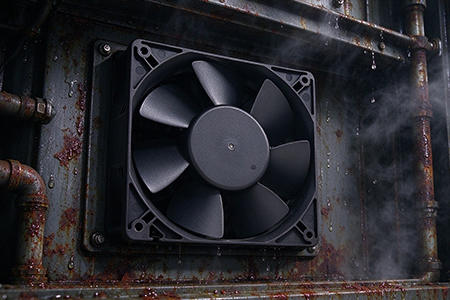
The role of car seat cooling fan in car seat ventilation system

Have you ever experienced such a scene in the scorching summer? Opening the car door, the heat wave rushed in, and the leather seats were like a hot iron plate. Even when the air conditioning was turned on to maximum, the back and hips were still hot and humid, and the discomfort of sweat sticking to the seats could not be ignored... This awkward experience is being put to an end by a seemingly low-key but crucial technology - the car seat ventilation system. The core "hero" of this system is the cooling fan hidden inside the seat.
1、 Seat ventilation system: from "passive tolerance" to "active adjustment"
The comfort of traditional car seats depends on the choice of materials and fillers, but in high temperature or long-term driving scenarios, the contact surface between the human body and the seat is prone to accumulate heat and moisture, leading to discomfort and even health hazards (such as prickly heat and fungal growth). The emergence of seat ventilation systems has upgraded seats from "static tools" to "dynamic adjustment devices", and the cooling fan is the core power source to achieve this function.
The working principle of the cooling fan:
In an active ventilation system, the fan generates airflow by rotating, drawing in or expelling external air from the interior of the seat. The air flows through the pre-set micro holes on the surface of the seat, taking away the heat and moisture emitted by the human body, forming a circulating heat dissipation. According to different designs, fans can be divided into two modes:
Suction type (mainstream high-end models): The fan draws air outward and guides it from the surface of the seat through negative pressure, resulting in a softer body feel and lower noise;
Blow drying (economical solution): The fan blows air towards the surface of the seat, directly accelerating the airflow and cooling faster, but may produce a noticeable wind sensation.
In an active ventilation system, the fan generates airflow by rotating, drawing in or expelling external air from the interior of the seat. The air flows through the pre-set micro holes on the surface of the seat, taking away the heat and moisture emitted by the human body, forming a circulating heat dissipation. According to different designs, fans can be divided into two modes:
Suction type (mainstream high-end models): The fan draws air outward and guides it from the surface of the seat through negative pressure, resulting in a softer body feel and lower noise;
Blow drying (economical solution): The fan blows air towards the surface of the seat, directly accelerating the airflow and cooling faster, but may produce a noticeable wind sensation.
2、 The Four Core Values of Cooling Fans
Temperature regulation: breaking the trap of "local high temperature"
The cooling fan rapidly reduces the surface temperature of the seat through forced convection (experimental data shows that the temperature of the seat contact surface can drop by 8-12 ℃ within 5 minutes after opening ventilation), avoiding the embarrassment of "air conditioning blowing cold face, back sauna".
Temperature regulation: breaking the trap of "local high temperature"
The cooling fan rapidly reduces the surface temperature of the seat through forced convection (experimental data shows that the temperature of the seat contact surface can drop by 8-12 ℃ within 5 minutes after opening ventilation), avoiding the embarrassment of "air conditioning blowing cold face, back sauna".
Humidity control: Say goodbye to the "sticky feeling"
When the human body is sitting for a long time, it can secrete about 20-50ml of sweat per hour. The airflow driven by the fan can accelerate the evaporation of sweat, keeping the contact surface dry, especially for leather seats or sports driving scenarios, which is of great significance.
When the human body is sitting for a long time, it can secrete about 20-50ml of sweat per hour. The airflow driven by the fan can accelerate the evaporation of sweat, keeping the contact surface dry, especially for leather seats or sports driving scenarios, which is of great significance.
Health protection: reduce the environment for bacterial growth
The humid and hot environment is a breeding ground for fungi, and the ventilation system suppresses microbial growth through continuous ventilation, which is particularly important for allergy prone individuals or child passengers.
The humid and hot environment is a breeding ground for fungi, and the ventilation system suppresses microbial growth through continuous ventilation, which is particularly important for allergy prone individuals or child passengers.
Energy consumption optimization: a smarter cooling solution than air conditioning
The power consumption of seat ventilation is much lower than that of car air conditioning (usually 3-10W for a single fan), and the characteristic of local cooling can reduce the intensity of air conditioning use, indirectly reducing fuel consumption (fuel vehicles) or improving range (electric vehicles).
The power consumption of seat ventilation is much lower than that of car air conditioning (usually 3-10W for a single fan), and the characteristic of local cooling can reduce the intensity of air conditioning use, indirectly reducing fuel consumption (fuel vehicles) or improving range (electric vehicles).
3、 Technical details: "Black technology" hidden inside the fan
Silent design: Adopting fluid dynamics optimized blade shape and shock-absorbing bracket to ensure that the noise of the fan is below 30dB at 2000-3000rpm speed;
Intelligent speed regulation: Real time monitoring of passenger status through pressure/humidity sensors, automatic adjustment of wind speed (such as Lexus LS' "Synaptic Synapse" system);
Energy saving and durability: The brushless DC motor paired with ceramic bearings can have a lifespan of over 5000 hours and consume only 60% of traditional motors.
4、 Future trend: From single heat dissipation to intelligent ecology
With the development of intelligent automobiles, the role of seat cooling fans is expanding:
Linkage with air conditioning: Based on the temperature and humidity inside and outside the car, automatically coordinate the air conditioning output volume with the seat ventilation level (such as Mercedes Benz Energizing package);
Partition control: achieve independent temperature control of seats/backrests through multi fan layout, and even support differentiated settings for left and right seats;
Health monitoring: integrating biosensors to analyze sweat composition and indicate dehydration risk or fatigue status;
Environmental innovation: Green technologies such as biodegradable biobased fan blades and photovoltaic assisted power supply are gradually being implemented.
Types and adjustment methods of blades for DC centrifugal fans
The future of cooling fans: how new materials and intelligent technologies can disrupt the industry?