Selection of cooling fan: How to comprehensively consider factors such as motor power, speed, and air pressure
σīu | 2025-02-15

The selection of cooling fans requires comprehensive consideration of multiple factors such as motor power, speed, air pressure, air volume, noise, lifespan, and system compatibility. The following is a systematic selection method to help you make reasonable choices under different needs:
1. Definition and Relationship of Core Parameters
Airflow (CFM, m ³/h)
The volume of air delivered by the fan per unit time determines the heat dissipation capacity.
Formula: Airflow ∝ Speed × Blade Area × Blade Design.
Formula: Airflow ∝ Speed × Blade Area × Blade Design.
Wind pressure (Pa or mmH ₂ O)
The ability of a fan to overcome system resistance such as ducts, filters, and heat sinks.
Key point: Insufficient air pressure can prevent airflow from penetrating the radiator, and even high air volume is ineffective.
Key point: Insufficient air pressure can prevent airflow from penetrating the radiator, and even high air volume is ineffective.
Speed (RPM)
Directly affecting air volume and pressure, but high speed will increase noise and shorten lifespan.
Directly affecting air volume and pressure, but high speed will increase noise and shorten lifespan.
Motor power (W)
The higher the power, the greater the wind pressure/volume, but the higher the energy consumption and heat generation, which determines the driving force of the fan.
The higher the power, the greater the wind pressure/volume, but the higher the energy consumption and heat generation, which determines the driving force of the fan.
2. Selection steps
A. Determine the heat dissipation requirements
Calculate thermal power consumption: Estimate the required heat dissipation based on the device's heat generation (such as chip TDP).
Target temperature rise: Determine the allowable temperature rise (Δ T) based on the maximum temperature allowed by the equipment and the ambient temperature.
Formula simplification:
Required Air Volume (CFM)=Thermal Power Consumption (W) × 0.05 Δ T (° C)
Required air volume (CFM)=Δ T (° C) Thermal power consumption (W) × 0.05
(Note: 0.05 is an empirical coefficient, applicable to approximate values of specific heat capacity and density of air)
Calculate thermal power consumption: Estimate the required heat dissipation based on the device's heat generation (such as chip TDP).
Target temperature rise: Determine the allowable temperature rise (Δ T) based on the maximum temperature allowed by the equipment and the ambient temperature.
Formula simplification:
Required Air Volume (CFM)=Thermal Power Consumption (W) × 0.05 Δ T (° C)
Required air volume (CFM)=Δ T (° C) Thermal power consumption (W) × 0.05
(Note: 0.05 is an empirical coefficient, applicable to approximate values of specific heat capacity and density of air)
B. Evaluate the system's wind resistance
Wind resistance curve: measures or estimates the static pressure air volume curve (P-Q curve) of a cooling system.
Key principle: The working point of the fan (air volume+air pressure) should be located at the intersection of its P-Q curve and the system resistance curve.
Wind resistance curve: measures or estimates the static pressure air volume curve (P-Q curve) of a cooling system.
Key principle: The working point of the fan (air volume+air pressure) should be located at the intersection of its P-Q curve and the system resistance curve.
C. Choose the type of fan
Fan type applicable scenario characteristics
Axial flow fans have low air resistance, high air volume (such as in open spaces), high air volume, low air pressure, and low noise
Centrifugal fan with high air resistance, narrow air duct with high air pressure, moderate air volume, and high noise
Mixed flow fan with high air resistance, long air duct to balance air volume and pressure, and small volume
Fan type applicable scenario characteristics
Axial flow fans have low air resistance, high air volume (such as in open spaces), high air volume, low air pressure, and low noise
Centrifugal fan with high air resistance, narrow air duct with high air pressure, moderate air volume, and high noise
Mixed flow fan with high air resistance, long air duct to balance air volume and pressure, and small volume
D. Balance speed and power
High speed: High air volume/pressure, but high noise and short lifespan (fast bearing wear).
Low speed: low noise, long lifespan, but requires increasing blade size or optimizing design compensation performance.
Motor power matching: Ensure that the motor can provide sufficient torque to avoid overheating caused by overload operation.
High speed: High air volume/pressure, but high noise and short lifespan (fast bearing wear).
Low speed: low noise, long lifespan, but requires increasing blade size or optimizing design compensation performance.
Motor power matching: Ensure that the motor can provide sufficient torque to avoid overheating caused by overload operation.
E. Noise control
Noise formula (approximate):
Noise (dB) ∝ log 10 (RPM)+0.5 × log 10 (airflow)
Noise (dB) ∝ log10 (RPM)+0.5 × log10 (airflow)
Noise formula (approximate):
Noise (dB) ∝ log 10 (RPM)+0.5 × log 10 (airflow)
Noise (dB) ∝ log10 (RPM)+0.5 × log10 (airflow)
Noise reduction strategy:
Choose a large-sized low-speed fan (such as a 120mm fan instead of an 80mm fan).
Adopting PWM speed regulation to dynamically adjust the speed.
Use shock absorbers or soft connections to reduce resonance.
Choose a large-sized low-speed fan (such as a 120mm fan instead of an 80mm fan).
Adopting PWM speed regulation to dynamically adjust the speed.
Use shock absorbers or soft connections to reduce resonance.
F. Lifespan and reliability
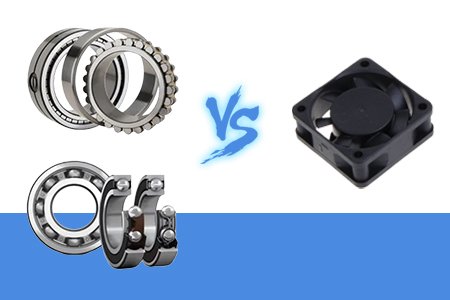
Bearing type:
Oil bearing: Low cost, with a lifespan of approximately 30000 hours.
Ball bearings: high cost, lifespan of over 80000 hours, high temperature resistance.
Environmental adaptation: Models with high IP protection levels should be selected for high temperature and dust environments.
Bearing type:
Oil bearing: Low cost, with a lifespan of approximately 30000 hours.
Ball bearings: high cost, lifespan of over 80000 hours, high temperature resistance.
Environmental adaptation: Models with high IP protection levels should be selected for high temperature and dust environments.
3.Common Misconceptions
Blindly pursuing high air volume: Ignoring wind pressure matching can lead to poor actual heat dissipation effect.
Neglecting system wind resistance: Failure to measure the wind resistance curve resulted in a deviation of the fan operating point.
Ignore environmental temperature: High temperature environments require the selection of high-temperature resistant motors (such as insulation level of 105 ℃).
Neglecting system wind resistance: Failure to measure the wind resistance curve resulted in a deviation of the fan operating point.
Ignore environmental temperature: High temperature environments require the selection of high-temperature resistant motors (such as insulation level of 105 ℃).
4. Recommended selection tools
Simulation software: ANSYS Fluent, COMSOL (Air Duct Fluid Simulation).
Online calculator: ebm-papst FanSelect、Sanyo Denki Fan Simulator。
Testing tool: Air volume and pressure tester (such as Testo 405i).
Simulation software: ANSYS Fluent, COMSOL (Air Duct Fluid Simulation).
Online calculator: ebm-papst FanSelect、Sanyo Denki Fan Simulator。
Testing tool: Air volume and pressure tester (such as Testo 405i).
The future of cooling fans: how new materials and intelligent technologies can disrupt the industry?
The benefits of using PBT material for the cooling fan frame blades
Related blog