From PC to AI Hardware: The New Trend of Consumer Electronics Cooling Fans in 2025
σīu | 2025-04-21

The new battlefield of consumer electronics for cooling fans
In the past decade, the core application scenarios of cooling fans have been concentrated in PCs, servers, and industrial equipment. However, with the explosion of AI computing power, the popularity of high-performance computing (HPC), and the continuous rise in power consumption of consumer electronic devices, the demand for heat dissipation is ushering in a new round of growth. By 2025, the consumer electronics cooling fan market will no longer be limited to traditional PCs, but will expand into emerging fields such as AI hardware, gaming devices, AR/VR, forming a billion dollar incremental market.
1、 Traditional PC market: High performance drives heat dissipation upgrade
Despite the slowdown in global PC market growth, the cooling demand for high-performance laptops, gaming PCs, and workstations is still growing rapidly
CPU/GPU power consumption exceeds 200W: The TDP of Intel Meteor Lake, AMD Zen5, and NVIDIA RTX 50 series graphics cards continues to rise, and traditional single fan cooling solutions are no longer able to meet the demand. Dual fan+heat spreader design has become a standard for high-end laptops.
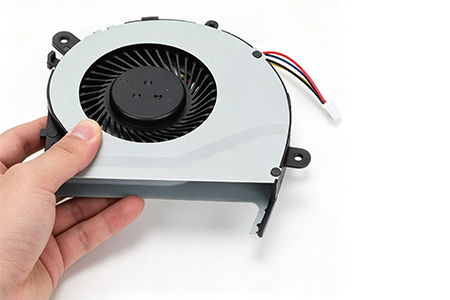
Ultra thin laptop heat dissipation challenge: With the popularity of OLED screens and ultrabooks, how to achieve efficient heat dissipation in limited space has become the key, and ultra-thin turbofans and graphene thermal conductive films have become new trends.
Liquid cooled PCs enter consumer level: By 2025, it is expected that 10% of high-end gaming PCs will adopt a solution of miniaturized liquid cooling modules and auxiliary fans, and fan manufacturers are deeply cooperating with cooling system suppliers.
2、 AI hardware explosion: the cooling revolution of computing devices
1. AI PC and Local Large Model Reasoning
1. AI PC and Local Large Model Reasoning
Starting from 2024, Intel、AMD、 Qualcomm and other manufacturers are vigorously promoting the concept of "AI PC", and localized large models (such as Stable Diffusion, Llama 3) require stronger heat dissipation support for operation:
The addition of NPU (Neural Network Processor) requires the notebook cooling system to simultaneously cope with the collaborative heating of CPU+GPU+NPU.
Low noise and high wind pressure fans have become a necessity, and the sustained high power consumption under AI loads requires fans to have intelligent speed regulation capabilities.
2. AI servers and edge computing devices
A single AI training server (such as NVIDIA DGX series) needs to be equipped with dozens of high-speed fans, and the global AI server market is expected to exceed $100 billion by 2025, driving high-end cooling demand.
The demand for small silent fans has surged for edge AI devices such as smart cameras and autonomous driving computing units, making dustproof and waterproof design key.
3、 Gaming and AR/VR: The Thermal Challenge of Immersive Experience
1. Game consoles and handheld devices
1. Game consoles and handheld devices
The PS5 Pro and Xbox next-generation consoles both use more powerful chips, and the heat dissipation module has been upgraded to a double-sided centrifugal fan+liquid metal thermal conductivity.
The handheld market (such as Steam Deck and ROG Ally) is limited by size and requires more efficient ultra-thin fans and heat dissipation plate solutions.
2. AR/VR devices
High end headsets such as the Apple Vision Pro use M2/M3 chips, which pose a heat dissipation challenge due to high-performance computing. The key is the use of a silent and seamless fan.
Future lightweight AR glasses may adopt micro piezoelectric fans (Piezo Fans) to achieve zero noise heat dissipation.
4、 Technology Trends: Four Major Upgrades for Cooling Fans in 2025
More intelligent: Integrated temperature sensor, AI dynamically adjusts speed, reducing energy consumption by more than 20%.
Quieter: Magnetic Levitation technology reduces noise to below 25dB.
Thinner and thinner: 3D printed fan blades and graphene materials are used to reduce the thickness of the fan to below 5mm.
More efficient: Biomimetic design (such as owl shaped fan blades) increases air volume by 30%.
5、 Market Landscape: Can Chinese Manufacturers Overtake the Curve?
Taiwanese manufacturers (Delta, Jianzhun) still dominate the high-end market, supplying brands such as Apple and Dell.
Mainland manufacturers (AVC, overclocking three) are accelerating their layout of AI hardware cooling and entering the supply chains of Huawei and Xiaomi.
Japan (Nidec) and Germany (Ebm papst) maintain a leading position in silent technology.
By 2025, the global consumer electronics cooling fan market is expected to exceed $8 billion, with an annual growth rate of 15%, and AI hardware will become the biggest driving force.
Conclusion: The future of "intelligence+miniaturization" of cooling fans
From traditional PCs to AI hardware, cooling fans are undergoing a dual transformation of technological iteration and market expansion. In 2025, smarter, quieter, and more efficient heat dissipation solutions will become standard in the industry, and it is worth looking forward to whether Chinese manufacturers can achieve breakthroughs in the high-end market.
Industry 4.0 and Green Energy: Innovative Applications of Cooling Fans in Smart Manufacturing
New Energy Vehicles and Energy Storage: The Next Billion Dollar Market for Cooling Fans
Related blog