Are DC fans suitable for all devices?
σīu | 2025-06-03

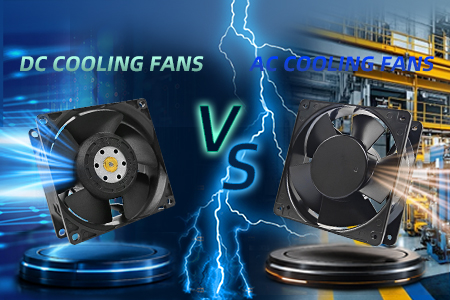
Heat dissipation is a crucial factor in modern electronic devices, and fans, as one of the most common active heat dissipation methods, are widely used in computers, servers, home appliances, industrial equipment and other fields. Direct current (DC) fans have gained popularity in recent years due to their high efficiency, energy saving and low noise levels. However, are DC fans really suitable for all devices?
Advantages of DC fans
Energy efficient:
Compared with alternating current (AC) fans, DC fans usually use brushless motors (BLDC) that dynamically adjust their speed according to the temperature (PWM control), resulting in lower power consumption at low loads and higher energy efficiency ratios.
Compared with alternating current (AC) fans, DC fans usually use brushless motors (BLDC) that dynamically adjust their speed according to the temperature (PWM control), resulting in lower power consumption at low loads and higher energy efficiency ratios.
Low noise:
DC fans have a wider range of adjustable speeds and can maintain lower noise levels at low loads, making them suitable for environments that require high levels of silence, such as home computers and office equipment.
DC fans have a wider range of adjustable speeds and can maintain lower noise levels at low loads, making them suitable for environments that require high levels of silence, such as home computers and office equipment.
Compact size:
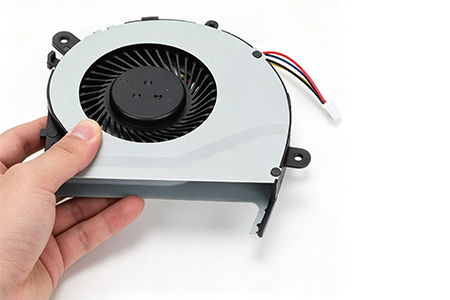
DC fans are usually compact and suitable for space-constrained equipment such as laptops, small servers or embedded systems.
DC fans are usually compact and suitable for space-constrained equipment such as laptops, small servers or embedded systems.
Long Life:
Brushless DC motors reduce mechanical wear and tear, resulting in a longer lifespan and lower maintenance costs compared to traditional brushed motors.
Brushless DC motors reduce mechanical wear and tear, resulting in a longer lifespan and lower maintenance costs compared to traditional brushed motors.
Limitations of DC Fans
Although DC fans have many benefits, they are not suitable for all scenarios and the following are their possible limitations:
High power demand equipment may not be suitable:
In industrial equipment that requires extremely high airflow or air pressure (e.g., large cooling systems, heavy machinery), AC fans may still be more advantageous because they provide higher power output.
Dependence on a stable DC power supply:
DC fans require a stable DC voltage (e.g., 12V, 24V, etc.). If the equipment itself only provides AC power (e.g., certain household appliances or industrial equipment), additional rectifier circuits or power adapters are required, adding cost and complexity.
DC fans require a stable DC voltage (e.g., 12V, 24V, etc.). If the equipment itself only provides AC power (e.g., certain household appliances or industrial equipment), additional rectifier circuits or power adapters are required, adding cost and complexity.
Poor adaptability to extreme environments:
In environments with high temperatures, high humidity, or strong electromagnetic interference, certain low-quality DC fans may have stability issues, while industrial-grade AC fans typically have greater environmental adaptability.
Cost Factors:
While DC fans are more energy efficient over the long term, their initial cost may be higher than regular AC fans, and for applications with limited budgets that are not energy sensitive (such as certain low-end appliances), AC fans may still be a more economical choice.
While DC fans are more energy efficient over the long term, their initial cost may be higher than regular AC fans, and for applications with limited budgets that are not energy sensitive (such as certain low-end appliances), AC fans may still be a more economical choice.
Recommendations for Applicable Scenarios
Based on the above analysis, DC fans are more suitable for the following devices:
Consumer electronics: such as computers, game consoles, routers, etc.
Data centers and servers: environments that require precise temperature control and low noise.
Portable devices: such as projectors, drones, and other devices that rely on battery power.
Smart home: such as air purifiers, fresh air systems and other appliances that require silent operation.
And AC fans may be more suitable:
Industrial high-power equipment: such as large ventilation systems, heavy machinery cooling.
Low-cost appliances: such as traditional electric fans, low-end air conditioners, etc.
Special environments: such as high-temperature workshops, outdoor equipment, and other scenarios that require greater durability.
Conclusion
DC fans have become the preferred choice for many modern devices due to their energy-saving, silent and intelligent speed control advantages, but they are not a “one-size-fits-all” solution. When choosing a fan, it is important to consider the type of power supply, cooling requirements, environmental conditions and cost budget of the equipment. For high power or specialized environmental applications, AC fans may still be a more reliable choice. Therefore, DC fans are not suitable for all devices, but they perform well in most modern electronic devices and will be further expanded in the future as technology advances.
Cooling Fan Technology Explained: From Basic to Advanced Applications
Why do large size cooling fans have metal frames?
Related blog