Axial-Flow Power Supply Cooling Fan: Solving Power Supply Heat Dissipation and Noise Issues

In the digital age, computers have become indispensable core tools for our work, entertainment, and creativity. Whether it's an exhilarating gaming battle or demanding video rendering, every component inside the computer operates under heavy load, generating significant heat. As the “powerhouse” of the entire system, the stability of the power supply unit (PSU) directly determines the system's survival.
Have you ever encountered these frustrations?
● During high-load operations, an audible “humming” emanates from the case, causing irritation.
● Sudden blackouts and reboots while running demanding software or games, suspected to be caused by the PSU “giving up.”
● Touching the PSU casing reveals it's scorching hot, raising concerns about its lifespan and safety.
At the core of these issues lie two critical factors: heat dissipation and noise. Standing at the forefront of solving both is today's star—the axial-flow PSU cooling fan.
1. Why Do Power Supplies Require Robust Heat Dissipation?
During operation, a power supply functions as a highly efficient energy converter, transforming alternating current (AC) into direct current (DC). However, this process is not 100% perfect; a portion of energy is inevitably dissipated as heat. While higher conversion efficiency (such as 80 Plus Gold/Platinum certifications) minimizes waste heat generation, residual heat remains unavoidable.
Excessive heat accumulation leads to:
1.Accelerated component degradation: Core components like capacitors and MOSFETs experience drastically shortened lifespans under high temperatures.
2.Reduced conversion efficiency: Semiconductor performance deteriorates at elevated temperatures, lowering conversion efficiency and generating more heat—creating a vicious cycle.
3.System instability: To protect itself, the power supply may trigger over-temperature protection (OTP), causing sudden shutdowns or reboots.
4.Safety hazards: In extreme cases, excessive heat can become a fire hazard.
Therefore, an efficient cooling fan is crucial for maintaining low temperatures, stability, and long-term reliability in power supply operation.
2. Axial Fans: Why Are They the Mainstay of Power Supply Cooling?
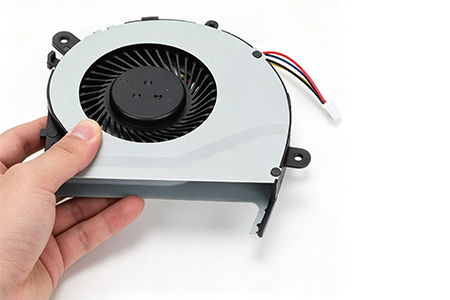
Among various fan types, axial fans are the most common and widely adopted solution for power supply cooling. Their operating principle is straightforward: blades propel air along the fan's axis, much like household electric fans.
Their popularity stems from core advantages:
● Direct-Blow Efficiency: They draw cool air directly into the unit and direct it toward the densely packed heat sinks and components inside the power supply. This direct airflow path ensures high cooling efficiency.
● Compact Design: Their small footprint makes them ideal for the narrow, confined metal enclosures typical of power supplies. They deliver maximum airflow within limited space.
● Cost-Effectiveness: With mature technology, their manufacturing and maintenance costs are relatively low, offering an ideal balance of performance and affordability.
3. Technological Advancements: How to Achieve Both “Cooling” and “Silence”?
Early power supply fans were notoriously loud. Today, technological progress has perfectly balanced thermal efficiency with noise control.
1.Intelligent Temperature Control (PWM/Thermal Speed Regulation)
This is the most critical technology. Modern high-quality power supply fans are equipped with intelligent temperature control chips. These chips use sensors to monitor internal temperatures in real time:
● During low load/low temperature: The fan operates at extremely low speeds (or even stops entirely, known as “0dB mode”), achieving complete silence to meet the quiet demands of light office work and multimedia browsing.
● During high load/high temperature: Fan speed increases linearly, boosting airflow to fully cool the power supply and ensure stability.
This “work when needed, rest when not” operational logic fundamentally resolves persistent noise issues.
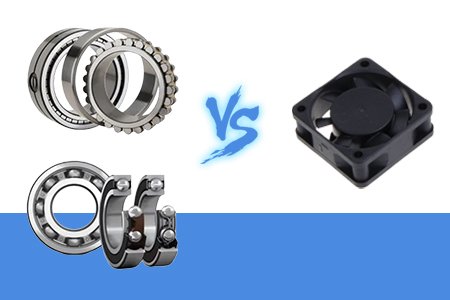
2.Fluid Dynamic Bearing (FDB)/Rifle Bearing
Traditional sleeve bearings suffer from wear, noise, and short lifespan. Advanced bearing technologies like FDB utilize complex oil film systems to drastically reduce friction and vibration, delivering:
● Extended lifespan (far exceeding standard bearings)
● Lower operating noise
● Enhanced reliability
3.Engineered Fan Blades
Aerodynamically optimized blade shapes (e.g., sickle-shaped, shark-fin-shaped) cut through more air at the same rotational speed. This generates greater airflow and pressure while reducing turbulence, thereby minimizing noise at its source.
4. Selection and Maintenance: Better Care for Your Heart
When choosing a power supply, beyond wattage and 80Plus certification, pay close attention to its fan:
● Look at technology: Prioritize products supporting intelligent start/stop and advanced bearing technologies like FDB.
● Look at size: Generally, larger sizes (e.g., 120mm, 135mm) require lower RPMs for the same airflow, resulting in quieter operation.
● Check the Brand: Reputable brands (like SeaSonic, Corsair, or Cooler Master) generally offer more reliable fan selection and tuning.
Daily maintenance is straightforward: Regularly clean dust from the PSU's intake grille and fan blades using compressed air or a soft-bristle brush. Keeping the airflow path clear ensures the fan operates efficiently and quietly at all times.
A small axial fan may seem unremarkable, yet it is the unsung hero safeguarding power supply stability and extending your computer's lifespan. Not only is it a formidable tool for heat dissipation, but it also excels at quiet operation. Technological innovation has transformed it from a former “noise source” into today's “silent guardian.”
Investing in a high-quality power supply equipped with an excellent cooling fan lays the most solid foundation for the stability and quiet operation of your entire computer system. Let it quietly channel energy, empowering you to give your all without a sound.
How effective are DC fans? — Delivering superior cooling solutions for industrial equipment
Innovative Application of Heat Dissipation Fans in Power Bank Products: The Key to Improving Efficiency and Safety