How effective are DC fans? — Delivering superior cooling solutions for industrial equipment

In thermal management solutions for industrial equipment, power electronics, communication cabinets, and similar applications, the selection of fans directly impacts system stability, energy consumption, and lifespan. As a thermal fan manufacturer, we understand your core concerns when choosing cooling solutions: efficiency, reliability, and total cost of ownership.
So, how effective are DC cooling fans? Could they be the superior choice for your next-generation products? This article provides an in-depth analysis from a professional manufacturer's perspective.
I. Beyond “Energy Savings”: Analyzing the Industrial-Grade Performance of DC Fans
Compared to traditional AC fans, DC fans achieve breakthrough improvements in key performance metrics through their underlying technology. Their core advantages extend far beyond mere energy efficiency.
1. Precise Speed Control and Intelligent Temperature Regulation
●Effect: DC fan speed can be precisely and linearly controlled via PWM (Pulse Width Modulation) or voltage signals. This enables real-time synchronization between fan speed and internal thermal sensors.
●Value: During low equipment load, fans operate at reduced speeds for quiet, energy-efficient performance. Under high load, speeds rapidly increase for powerful heat dissipation. This “on-demand” cooling approach avoids the constant full-speed operation typical of AC fans, significantly enhancing system intelligence and energy efficiency.
2. High Efficiency & Energy Savings, Reducing Total Cost of Ownership (TCO)
●Effect: DC motors achieve far higher conversion efficiency than AC motors. Under equivalent airflow conditions, power consumption is typically reduced by 30%–50% or more.
●Value: For industrial equipment requiring 24/7 operation and deployed in large quantities (e.g., server clusters, communication base stations), even minor electricity savings accumulate into substantial cost advantages over the entire lifecycle. DC fans directly reduce your customers' operational costs, becoming a major selling point for your products.
3. Exceptional Reliability and Long Service Life
●Effect: DC fans utilize electronic commutation technologies (e.g., BLDC, brushless DC), eliminating physically wear-prone components like carbon brushes found in AC fans. Precise speed control also reduces mechanical wear on bearings at extreme rotational speeds.
●Value: Extended MTBF (Mean Time Between Failures). This significantly reduces the risk of downtime in your end devices due to cooling fan failures, which is critical for industrial applications demanding high reliability.
4. Wider Voltage Operating Range
●Effect: Many industrial DC fans support wide voltage inputs (e.g., 12VDC or 24VDC with broad fluctuation tolerance).
●Value: In industrial environments with unstable power supplies, DC fans demonstrate superior adaptability, ensuring system stability even under complex operating conditions.
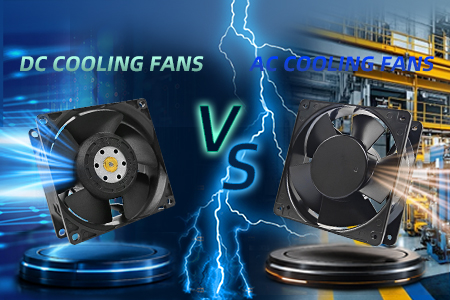
II. DC vs. AC: Choosing the Best Solution for Your Project
| Features | DC Cooling Fan | Traditional AC Fan | Industrial Applications Perspective |
| Control accuracy | High-precision stepless speed regulation, supporting PWM/VC | Fixed speed or limited speed steps | Enables intelligent temperature control to optimize system thermal management |
| Energy Efficiency | High, with significantly lower power consumption at equivalent airflow | Lower | Reduces customer TCO and enhances product energy efficiency ratings |
| Noise Level | Low, controllable rotational speed delivers a quiet environment | Relatively high and difficult to reduce | Enhances end-user experience in office, medical, and similar settings |
| Reliability/Lifespan |
Long
(brushless design, minimal wear)
|
Relatively short | Reduce after-sales rates and enhance brand credibility |
| System Complexity |
Requires DC power supply, slightly more complex
control circuitry
|
Direct AC power connection,simple | Requires planning during product design phase, but delivers long-term benefits |
III. Customization Services: Tailoring DC Fans to Your Product
As a professional cooling fan manufacturer, we understand that standard products may not meet all requirements. The flexibility of DC fans provides an ideal foundation for customization. Based on your specific needs, we offer:
●Dimension and Structure Customization: Non-standard sizes, special frames, and air guide ring designs.
●Performance Curve Optimization: Tailored airflow and pressure curves to match your equipment's air resistance characteristics.
●Wire and Connector Customization: Compatible with your motherboard interfaces for simplified installation.
●Control Signal Compatibility: Seamless integration with PWM or voltage control signals from your MCU.
●Special environment adaptation: Enhanced features like dustproofing, waterproofing (IP rating), high-temperature resistance, and corrosion resistance.
Through customization, you gain more than just a fan—you receive an optimized thermal subsystem seamlessly integrated into your product.
IV. Conclusion: DC Fans Are the Inevitable Future of Industrial Thermal Management
Returning to the initial question: How effective are DC fans?
Technically, they deliver comprehensive performance advantages over AC solutions in controllability, energy efficiency, and reliability.
Commercially, they help your end products establish a competitive edge in the market as “highly efficient, intelligent, and reliable.”
For new product designs, especially in applications demanding low power consumption, low noise, and intelligent control, selecting DC cooling fans is no longer a “nice-to-have” but a “must-have.”
We specialize in delivering high-quality, customizable DC cooling fan solutions for industrial clients. If you're evaluating thermal solutions for a new project, we invite you to contact us. Our engineering team stands ready to provide expert technical support and complimentary sample testing, working together to build a powerful yet quiet “heart” for your equipment.
Air-Conditioned Workwear Cooling Fan: The Portable Cooling Core for Workers in High-Temperature Environments
Axial-Flow Power Supply Cooling Fan: Solving Power Supply Heat Dissipation and Noise Issues