How can cooling fans help AI high computing power servers run efficiently and stably
σīu | 2025-04-01

Introduction: High computing power challenges in the AI era
With the rapid development of artificial intelligence technology, AI servers, as the hardware foundation supporting this revolutionary technology, are facing unprecedented computing demands. Modern AI model training requires processing massive amounts of data and performing complex matrix operations, which places extremely high demands on the computing power of servers. However, with high computing power comes a huge heat generation problem - if the heat generated by processors during high-speed operations cannot be effectively dissipated in a timely manner, it will directly lead to performance degradation, system instability, and even hardware damage.
With the rapid development of artificial intelligence technology, AI servers, as the hardware foundation supporting this revolutionary technology, are facing unprecedented computing demands. Modern AI model training requires processing massive amounts of data and performing complex matrix operations, which places extremely high demands on the computing power of servers. However, with high computing power comes a huge heat generation problem - if the heat generated by processors during high-speed operations cannot be effectively dissipated in a timely manner, it will directly lead to performance degradation, system instability, and even hardware damage.
1、 The heat dissipation dilemma of AI high computing power servers
1.1 Heating characteristics of high-density computing
Modern AI servers are typically equipped with multiple high-performance CPUs and GPUs, such as NVIDIA's A100, H100 and other acceleration cards, which can have a TDP (thermal design power consumption) of up to 400-700 watts. A standard rack mounted server may contain 8 or even more such acceleration cards, with a total power consumption of several kilowatts and generating astonishing heat.
1.1 Heating characteristics of high-density computing
Modern AI servers are typically equipped with multiple high-performance CPUs and GPUs, such as NVIDIA's A100, H100 and other acceleration cards, which can have a TDP (thermal design power consumption) of up to 400-700 watts. A standard rack mounted server may contain 8 or even more such acceleration cards, with a total power consumption of several kilowatts and generating astonishing heat.
1.2 Triple threat of overheating
Performance frequency reduction: Modern processors have temperature protection mechanisms that automatically reduce operating frequency to minimize heat generation when the core temperature reaches a threshold
System instability: Long term high-temperature operation can accelerate the aging of electronic components and increase the risk of system collapse
Hardware lifespan shortened: Research shows that for every 10 ° C increase in operating temperature, the lifespan of electronic components may be reduced by half
2、 The technological evolution of cooling fans
2.1 From ordinary fans to intelligent speed regulating fans
Traditional server fans typically use fixed speed or simple temperature control strategies, while modern AI server fans have developed into:
Traditional server fans typically use fixed speed or simple temperature control strategies, while modern AI server fans have developed into:
Multi zone temperature monitoring: in CPU GPU、 Install temperature sensors in key locations such as memory and power supply
Dynamic PWM speed regulation: Accurately adjust fan speed based on real-time temperature data
Predictive speed regulation algorithm: predict the temperature change trend based on the workload, and adjust the cooling strategy in advance
2.2 Balance design between high wind pressure and high air volume
AI server cooling fans face unique challenges:
High wind pressure design: Overcoming internal air resistance in densely arranged servers
Efficient air duct optimization: Collaborate with server chassis design to create directional airflow
Noise control technology: reducing noise levels while ensuring heat dissipation efficiency
3、 Application of advanced cooling solutions in AI servers
3.1 Hybrid cooling solution
Leading server manufacturers adopt a hybrid solution of "fan+liquid cooling":
The main heat is still discharged by the powerful fan system
Key hotspot areas (such as GPU) supplemented by liquid cooling modules
Dynamically adjust the ratio of two heat dissipation methods based on the load
3.2 Intelligent Cooling Management System
Load aware cooling: Predicting heating patterns by monitoring and calculating task types and intensities
Fault warning function: Monitor the health status of the fan and provide early warning of possible faults
Energy efficiency optimization algorithm: Minimize energy consumption while ensuring heat dissipation efficiency
4、 Selection and maintenance points of cooling fan
4.1 Choose a fan suitable for AI servers
4.1 Choose a fan suitable for AI servers
CFM (cubic feet per minute) metric: High computing power servers typically require air flow of 80-120CFM or more
Static pressure capacity: at least 0.3-0.5 inches of water column to overcome system resistance
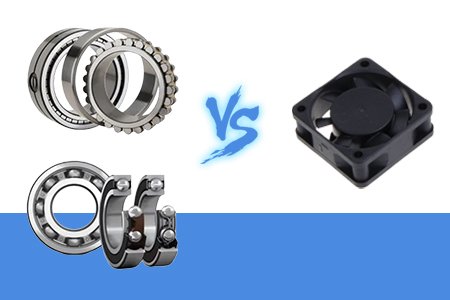
Bearing type: Double ball bearings are more durable than hydraulic bearings and suitable for 24/7 operating environments
MTBF (Mean Time Between Failures): High quality server fans should reach 150000 hours or more
4.2 Daily maintenance suggestions
Regularly clean the dust on the fan filter and heat sink
Monitor whether the fan speed curve is normal
Pay attention to abnormal noise, which may be an early signal of bearing wear
Consider preventive replacement of critical position fans every 2-3 years
5、 Future Trends: Innovative Directions in Heat Dissipation Technology
5.1 Smarter adaptive cooling
5.1 Smarter adaptive cooling
Dynamic heat dissipation strategy based on machine learning
Chip level temperature sensing and precise cooling
Optimization of 3D air duct design
5.2 New Materials and New Structures
Application of New Thermal Conductive Materials such as Graphene
Biomimetic heat dissipation structure design
Micro turbofan technology
5.3 Collaborative optimization of heat dissipation and energy efficiency
The energy consumption of the cooling system accounts for 15-25% of the total energy consumption of the server
The next generation of cooling solutions will focus more on overall PUE (power efficiency) optimization
Conclusion: Heat dissipation - the invisible guardian of AI computing power
In today's rapidly advancing AI technology, the importance of the cooling system as the hero behind the stable operation of servers is no less than that of the processor itself. A high-quality heat dissipation solution not only ensures uninterrupted AI training tasks, but also significantly reduces the total cost of ownership (TCO). With the continuous innovation of heat dissipation technology, we have reason to believe that future AI servers will be able to achieve more efficient and stable operation while having higher
computing power.
For enterprises that are deploying or upgrading AI infrastructure, investing in advanced cooling systems is not an option, but a necessary path to ensure the maximum value of computing resources. In the pursuit of peak computing power, the seemingly simple component of the cooling fan is playing an increasingly crucial role.
The golden race track for cooling fans in 2025: explosive demand for data centers and 5G infrastructure
Semiconductor Heat Sink: Principle and Case Analysis
Related blog